

Up:An Equational Relation forPrevious:External Choice
Up:An
Equational Relation forPrevious:External
Choice
Let  and
and  be the processes as follows:
![$\begin{array}[t]{ll}P\stackrel{\mbox{\scriptsize\it def}}{=}a[P_1]+a[P_2].\\......]+b[].\\Q_2\stackrel{\mbox{\scriptsize\it def}}{=}a[Q_2]+c[].\\\end{array}$](img33.png)
According to Definition .1
for ``+'',
and
have the following structure:
![\begin{displaymath}\hspace{-.5em}\begin{array}[t]{ll}P\equiv (\nu \mbox{\it ......rash}[\mbox{\it out $a$}]\vert Q_2)] ).\end{array}\end{array}\end{displaymath}](img34.png)
The behavior of
and
are illustrated by Fig. 1.
![\begin{figure}\begin{center}\psbox[scale=.7]{tatetree.eps}\end{center} \end{figure}](img35.png) |
![$n[!\mbox{\it in $a$}\vert\mbox{\it in $c$}]$](img36.png) is running parallel to the process ,
the traveling ambient will be able to enter into the ambient
is running parallel to the process ,
the traveling ambient will be able to enter into the ambient ![$b[]$](img37.png) in
though this may be impossible when the traveling ambient is running parallel
to .
Contextual equivalence, however, identifies
and .
Intuitively,
and
are the processes as follows:
in
though this may be impossible when the traveling ambient is running parallel
to .
Contextual equivalence, however, identifies
and .
Intuitively,
and
are the processes as follows:
![\begin{displaymath}\begin{array}[t]{lll}P&\doteq&a[a[a[a[\cdots] +b[]]+c[]]+b[......]]+b[]]\\& &+a[a[a[a[\cdots] +c[]]+c[]]+c[]].\\\end{array}\end{displaymath}](img38.png)
If ``+'' is a primitive operator, any times of opening of ambient  ,
that is,
,
that is, 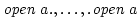 for
exhibits the pair of ambients
for
exhibits the pair of ambients![$a[]$](img40.png) and
or
and
and
or
and ![$c[]$](img41.png) .
The same opening operation for
can exhibits the same pair of ambient.
.
The same opening operation for
can exhibits the same pair of ambient. 
Our ``+'' operator defined in Definition .1
can be used like a primitive operator and when it works as primitive one,
the above explanation holds. While, our ``+'' is a macro defined by using
parallel operator, there exists a case in which ambients ,
and
are exhibited at the same time for .
The next example shows this situation:Example 3 Let
and
be the processes defined in Example 2 and  be a context as follows:
![\begin{displaymath}{\cal C}=n[!\mbox{\it in $a$}] \vert !\mbox{\it open $a$} \vert -.\end{displaymath}](img43.png)
We can observe ambients ![$a[],b[]$](img44.png) and
at the same time in the following computation for
and
at the same time in the following computation for  :
:
![\begin{displaymath}\hspace{-2em}\begin{array}[t]{ll}\mbox{${\cal C}(P)$}\mbox......h}[\mbox{\it out $a$}]\\\vert P_1 \vert P_2 ).\end{array}\end{displaymath}](img46.png)
Thus, ambients
and
in  and
and  are exhibited. But, the same context
will exhibit
and
for
in the same sequence, thus, the procedure for proving contextual equivalence
can not distinguish
from .
are exhibited. But, the same context
will exhibit
and
for
in the same sequence, thus, the procedure for proving contextual equivalence
can not distinguish
from .