


Next:Example of contextual equivalentUpAn Equational Relation forPrevious:An Equational Relation for
Next:Example
of contextual equivalentUpAn
Equational Relation forPrevious:An
Equational Relation for
As an example of the simulation, we define an external choice which we can use for both deterministic and non-deterministic purpose as follows:
Definition 1 (External Choice Operation ``+'')
 be any processes of ambient calculus. Then, we define
![$b[B]+c[C]$](img12.png) as follows:
as follows:
![\begin{displaymath}\hspace{-1em}\begin{array}[b]{ll}b[B]+c[C]\\\stackrel{\m......}[\mbox{\it out $c$}] \vert C)]).\\\end{array} \end{array}\end{displaymath}](img13.png)
 Example
1 We explain the behavior of the choice operation ``+''
by the following transitions: when the ambient
Example
1 We explain the behavior of the choice operation ``+''
by the following transitions: when the ambient 
![$\mbox{\it in $b$}]$](img16.png) (we call it a traveling ambient) is running parallel to
(we call it a traveling ambient) is running parallel to ![$ a[b[]]+a[c[]]$](img17.png) ,
that is,
,
that is, ![\(n[\mbox{\it in $a$}.\mbox{\it in $b$}] \vert (a[b[]]+a[c[]]),\)](img18.png) the traveling ambient can enter into either the ambient
the traveling ambient can enter into either the ambient ![$a[\cdots]$](img19.png) of
of ![$a[b[]]$](img20.png) or
of
or
of ![$a[c[]]$](img21.png) .
Suppose it happened to choose the former:
.
Suppose it happened to choose the former:
![\begin{displaymath}\begin{array}[t]{ll}\begin{array}[t]{ll}\mbox{$\Yields^{\m......ace{12.3em} \vert c[])]),\end{array} \end{array} \end{array}\end{displaymath}](img22.png)
then, the capability 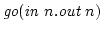 in
in ![$a[\cdots b[]]$](img24.png) is activated and consumed:
is activated and consumed:
![\begin{displaymath}\begin{array}[t]{ll}\begin{array}[t]{ll}\mbox{$\Yields^{\m......ce{12.3em} \vert c[])]),\end{array} \end{array} \end{array} \end{displaymath}](img25.png)
then, the ambients ![$\mbox{\it trash}[]$](img26.png) go out of the ambient :
go out of the ambient :
![\begin{displaymath}\begin{array}[t]{ll}\begin{array}[t]{ll}\mbox{$\Yields^{\m......2.3em} \vert c[])]),\end{array} \end{array}\\\end{array} \end{displaymath}](img27.png)
since the ambient
appeared as a sibling of the ambient
and ![$a[\cdots c[]]$](img28.png) ,
they can move into the ambient :
,
they can move into the ambient :
![\begin{displaymath}\begin{array}[t]{ll}\begin{array}[t]{ll}\mbox{$\Yields^{\m......a$}] \vert c[])]]),\end{array} \end{array}\\\end{array} \end{displaymath}](img29.png)
then, the only ambient which have been chosen by traveling ambient (that
is,
in this case) can escape from the ambient :
![\begin{displaymath}\begin{array}{ll}\begin{array}[t]{ll}\mbox{$\Yields^{\mbox......e{9.65em} \vert c[])]]),\end{array} \end{array} \end{array} \end{displaymath}](img30.png)
finally, the traveling ambient can reach the destination:
![\begin{displaymath}\begin{array}[t]{ll}\begin{array}[t]{ll}\mbox{$\Yields^{\m......e{9.65em} \vert c[])]] ).\end{array} \end{array} \end{array}\end{displaymath}](img31.png)
![$\mbox{\it trash}[\cdots]$](img32.png) are invisible from the environment, we find that our ``+'' can behave as
an ideal choice operator.
are invisible from the environment, we find that our ``+'' can behave as
an ideal choice operator.